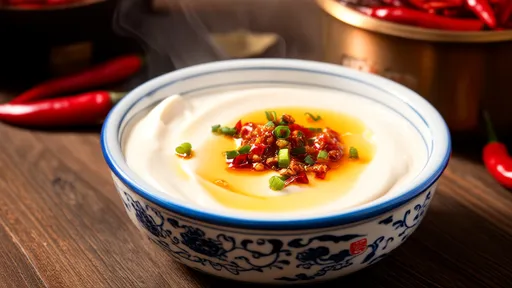
The sizzling allure of hot pot lies not just in its bubbling broth or thinly sliced meats, but in the often-overlooked companion that elevates every bite: the dipping sauce. Among the myriad of condiments, the garlic-infused sesame oil dip, known as "you die" in Mandarin, stands out as a cultural and culinary staple. But beyond its rich flavor, this unassuming sauce serves a scientific purpose—cooling scorching hot ingredients before they reach the diner’s mouth. The interplay between fiery broth and cool oil is a dance of physics and gastronomy, one that has been perfected over centuries yet remains underappreciated in Western culinary discourse.
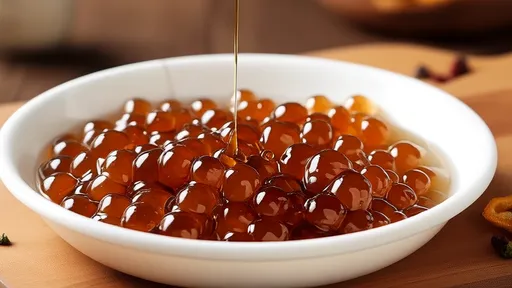
At first glance, the concept seems counterintuitive. How could a small bowl of oil possibly mitigate the searing heat of ingredients freshly fished from a boiling cauldron? The answer lies in thermal conductivity and the unique properties of sesame oil. Unlike water-based broths that transfer heat rapidly to mucous membranes (resulting in painful burns), viscous sesame oil acts as an insulating barrier. When food is dipped, the oil adheres to its surface, creating a temporary shield that slows heat conduction. This gives the diner precious extra seconds for the morsel’s core temperature to drop from near-boiling to a palatable range.
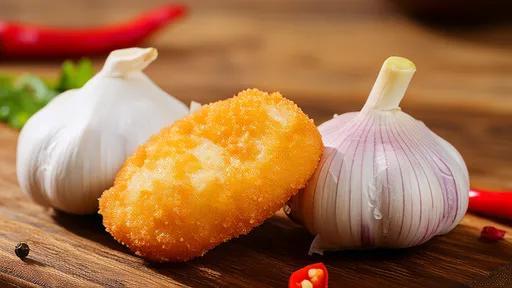
The garlic component plays an equally vital role. Crushed garlic releases allicin, a compound that stimulates saliva production. This biological response further aids temperature regulation as increased saliva helps dissipate residual heat upon chewing. Moreover, the pungent aroma of garlic triggers nasal receptors, creating a sensory distraction that subtly shifts focus from heat perception to flavor appreciation. Traditional Chinese medicine practitioners have long advocated garlic’s "cooling" properties—not in the literal sense, but as a balancing agent for "heaty" foods—a belief that aligns surprisingly well with modern thermoreceptor science.
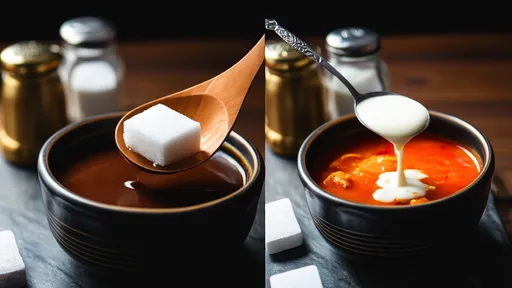
Regional variations reveal fascinating adaptations of this principle. In Chongqing’s infamous "ma la" (numbing-spicy) hot pots, the oil dip often incorporates peanut butter or fermented bean paste to increase viscosity, enhancing heat resistance. Sichuan versions might add sugar, not just for sweetness but because sucrose solutions have higher heat capacities than plain oils. Meanwhile, Beijing’s mutton hot pot tradition favors pure sesame oil with minimal additives, relying on the oil’s natural 210°C smoke point to handle the intense heat of copper vessel cooking. These localized tweaks demonstrate how empirical knowledge of thermal dynamics became encoded in culinary practice long before food science emerged as a formal discipline.
Modern studies confirm what generations of hot pot aficionados knew instinctively. A 2019 Journal of Food Engineering paper demonstrated that a 3mm coating of sesame oil reduced surface temperature of boiled beef by 22°C within five seconds—critical for preventing oral burns. Interestingly, the research also found that stirred garlic paste increased this cooling effect by another 5-7°C compared to ungrated cloves, validating traditional mortar-and-pestle preparation methods. Such findings bridge folk wisdom with laboratory data, revealing how ancestral cooking techniques often anticipated scientific principles through trial and error.
The cultural dimensions run equally deep. In communal hot pot dining, the personal oil dip becomes a canvas for self-expression—some diners heap chili flakes into theirs for added fire, while others temper theirs with herbs. This customization allows each participant to modulate their own heat tolerance while sharing the same central pot, embodying Confucian ideals of harmony amid diversity. The very act of dipping becomes a ritualized pause, a momentary withdrawal from the collective frenzy to prepare the next bite—a culinary metaphor for balance in social interaction.
As global interest in authentic hot pot experiences grows, understanding these nuances becomes crucial for chefs and food enthusiasts alike. The garlic sesame oil dip isn’t merely a flavor enhancer; it’s a sophisticated heat management system honed through millennia. From the thermal properties of pressed sesame seeds to the enzymatic reactions in crushed garlic, every element conspires to make blistering-hot ingredients safely enjoyable. In this light, the humble you die transforms from a simple condiment into a masterpiece of edible engineering—one that continues to protect tongues and delight palates in fiery dining rooms across the world.
By /Jul 31, 2025
By /Jul 31, 2025
By /Jul 31, 2025
By /Jul 31, 2025
By /Jul 31, 2025
By /Jul 31, 2025
By /Jul 31, 2025
By /Jul 31, 2025
By /Jul 31, 2025
By /Jul 31, 2025
By /Jul 31, 2025
By /Jul 31, 2025

By /Jul 31, 2025
By /Jul 31, 2025

By /Jul 31, 2025
By /Jul 31, 2025
By /Jul 31, 2025
By /Jul 31, 2025
By /Jul 31, 2025
By /Jul 31, 2025
