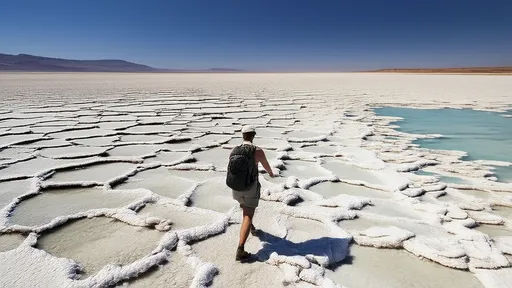
The Dead Sea, long celebrated for its therapeutic waters and effortless buoyancy, has unveiled an unexpected new attraction born from environmental crisis. As the hypersaline lake recedes at alarming rates – dropping over a meter annually – it leaves behind surreal landscapes of crystallized salt formations. What was once a uniform shoreline has transformed into a labyrinthine network of jagged salt towers, cavernous sinkholes, and snow-like salt plains that now draw adventurous travelers seeking something beyond the classic float.
Local guides have begun leading intrepid visitors through these otherworldly salt formations, dubbing the experience "Salt Crystal Maze Hiking." The hikes traverse freshly exposed seabed where the retreating waters have deposited intricate salt sculptures, some towering three meters high. "It feels like walking through a giant's broken glass collection," describes Noam Ben-David, a geotourism operator who pioneered the routes. "The crystals crackle underfoot, sunlight makes them sparkle like diamonds, and the formations change weekly as new ones emerge."
The science behind this phenomenon reveals why these structures appear so suddenly. As the Dead Sea's water level drops, underground freshwater dissolves salt layers, creating voids that collapse into sinkholes. The remaining salt crust fractures into geometric patterns, while evaporation forms new crystalline structures. Unlike Arctic ice caves or limestone caverns that take millennia to form, these salt mazes can develop overnight, with hikers sometimes witnessing the audible "pop" of new cracks splitting the saltpan.
Morning excursions prove most magical, when cooler temperatures make the salt crust stable for walking. As the sun rises, it illuminates the crystals' razor-sharp edges, creating prismatic light effects. The experience becomes multisensory – the crunch of salt under hiking boots, the mineral scent of drying seabed, and the startling contrast between the white salt forests and the Dead Sea's deep blue waters visible through gaps in the maze.
Safety remains paramount in this unpredictable environment. Guides carry ropes and metal detectors to identify unstable areas, as some salt crusts conceal meter-deep brine pools. The mineral-rich mud that once drew spa-goers now serves as emergency traction when hikers encounter slippery slopes. "It's not Disneyland," warns Ben-David. "Last month we had to reroute because a 20-meter salt bridge collapsed. That's part of the adventure – this landscape lives and breathes."
Beyond adventure tourism, the salt mazes have become open-air laboratories. Geologists monitor the formations to predict sinkhole development near highways, while crystallographers study the unique structures formed by the Dead Sea's complex mineral soup. Conservationists hope these striking visuals will raise awareness about the sea's ecological crisis, as its surface area has shrunk by 35% since 1960 due to water diversion and mineral extraction.
For visitors, the experience delivers profound contrasts. After navigating the harsh salt maze, they can wade into the Dead Sea's buoyant waters just meters away, the salt stinging fresh scrapes from crystalline encounters. As sunset paints the salt towers orange, the landscape feels simultaneously ancient and ephemeral – a disappearing world offering one final wonder before it vanishes into the desert air.
The emergence of salt maze hiking exemplifies how destinations adapt to environmental change. Where most see ecological disaster, adventure travelers find fleeting beauty. "These formations won't last," reflects Ben-David, chipping a piece of halite from a tower. "Maybe ten years until the salt erodes or the sinkholes swallow them. You're walking through something that's already gone." This poignant reality lends urgency to the experience, transforming what began as an alternative hiking route into a pilgrimage to witness climate change's accelerating impact.

By /Aug 6, 2025
By /Aug 6, 2025
By /Aug 6, 2025

By /Aug 6, 2025
By /Aug 6, 2025
By /Aug 6, 2025

By /Aug 6, 2025
By /Aug 6, 2025

By /Aug 6, 2025
By /Aug 6, 2025
By /Aug 6, 2025
By /Aug 6, 2025

By /Aug 6, 2025

By /Aug 6, 2025
By /Aug 6, 2025
By /Aug 6, 2025

By /Aug 6, 2025
By /Aug 6, 2025
By /Aug 6, 2025
By /Aug 6, 2025
