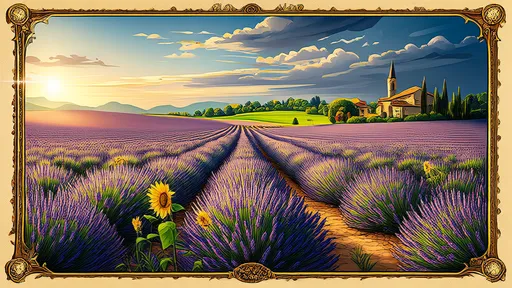
The lavender fields of Provence have long captivated photographers seeking that perfect blend of natural beauty and chromatic brilliance. What was once a matter of fortunate timing and local knowledge has now been transformed by artificial intelligence into a precise science of optimal photography conditions. The newly launched Provence AI Lavender Route represents a groundbreaking fusion of agricultural patterns, weather algorithms, and visual aesthetic analysis to guide photographers to the right place at exactly the right moment.
The Science Behind the Scenery
Behind this innovative system lies three years of data collection from across Provence's lavender-growing regions. Researchers fed thousands of historical photographs into machine learning models alongside corresponding meteorological data, GPS coordinates, and time stamps. The AI didn't just learn when lavender typically blooms - it developed an understanding of how different lighting conditions at various times of day interact with the purple hues to create visually striking compositions. It accounts for subtle factors like the angle of sunlight during golden hour at particular latitudes and how morning mist might soften colors in certain valleys.
What emerged was a predictive model that can advise photographers with remarkable accuracy. The system doesn't merely suggest general periods like "mid-June to early August." It can specify that the field near Sénanque Abbey will reach peak coloration between June 28-July 5 this particular year, and that the ideal shooting window on July 3 will be between 5:37-6:52 PM when the sun creates optimal shadow patterns across the rows of lavender.
Beyond the Obvious Locations
While iconic spots like the Abbey of Sénanque or the Plateau de Valensole remain included in the recommendations, the AI has uncovered numerous less-known locations that offer equally spectacular - and often less crowded - photographic opportunities. A small family farm near the village of Rustrel, for instance, appears in the algorithm's top recommendations due to its unique terrain that creates natural leading lines toward Mont Ventoux in the distance. Another surprise inclusion is a particular bend in the D6 highway where the elevation creates an extraordinary vantage point most human scouts would overlook.
The system has also identified temporal patterns that defy conventional wisdom. While most photography guides suggest early morning shoots, the AI found that certain fields actually photograph better in late afternoon when the sun's position creates a particular interplay between the lavender rows and surrounding oak trees. It recognizes how bloom cycles create different photographic opportunities - early bloom might offer more vibrant individual flowers, while peak bloom creates that signature sea of purple effect.
Adapting to Unpredictable Variables
One of the system's most impressive features is its ability to adjust recommendations based on unexpected weather changes. Integrated with real-time meteorological feeds, the AI can reshuffle its suggestions if an approaching storm system will create dramatic cloud formations over one valley while leaving another area flatly overcast. It might direct users to a north-facing slope when diffuse light conditions prevail, then switch recommendations to south-facing fields when clear skies return.
The algorithm also accounts for less obvious factors like tourist traffic patterns. Using anonymized mobile data, it can predict when certain popular spots will become overcrowded and suggest alternative locations with similar visual characteristics but fewer visitors. During last year's testing phase, this feature helped distribute tourist impact more evenly across the region while ensuring photographers could still capture stunning images without battling crowds.
The Human Element in an AI System
Despite its technological sophistication, the Provence AI Lavender Route maintains an important human component. Local growers provide ground-level updates about bloom conditions that fine-tune the algorithm's predictions. Professional photographers have reviewed thousands of the AI's recommendations to ensure they meet artistic standards, not just technical parameters. The result is a system that combines machine precision with human aesthetic sensibility.
Perhaps most importantly, the AI serves as a dynamic guide rather than a rigid prescription. It provides multiple options at different times of day, allowing photographers to choose based on their personal style. Those seeking high-contrast images might follow recommendations for midday shoots when the sun is directly overhead, while soft-light enthusiasts can find suggestions for overcast conditions that create beautifully muted tones.
Practical Implementation for Travelers
Accessing the AI's wisdom comes through a straightforward interface. Users input their travel dates and preferred shooting styles (landscape, close-up, drone photography etc.), and receive a customized itinerary updating in real-time. The system even suggests optimal routes between locations based on current traffic conditions. For those without professional equipment, it indicates which spots will yield good results with smartphone cameras versus those requiring specialized lenses.
Early adopters have reported remarkable success with the system. New York-based travel photographer Elena Rodriguez shared, "I've been coming to Provence for a decade, but the AI showed me angles and moments I'd never considered. It had me at a particular field near Banon at what seemed like an odd time - 3:15 PM - but when I arrived, the light was hitting the lavender in a way that made the rows look like purple laser beams. I would have never found that on my own."
The implications extend beyond photography. Local tourism officials note that by spreading visitors more evenly across the region and throughout the day, the system helps preserve the fragile beauty that draws people to Provence in the first place. Farmers benefit from increased visibility for their properties while avoiding the overtourism that can damage crops. It's a rare convergence of technology enhancing rather than diminishing an authentic natural experience.
As the system continues to learn from each season's data, its creators anticipate even more refined recommendations. Future versions may incorporate pollen counts for allergy sufferers or predict particularly aromatic periods when the lavender's fragrance is strongest. For now, it stands as perhaps the most sophisticated marriage of agricultural tradition and artificial intelligence - a digital-age enhancement to one of nature's most breathtaking displays.

By /Aug 6, 2025

By /Aug 6, 2025
By /Aug 6, 2025
By /Aug 6, 2025
By /Aug 6, 2025
By /Aug 6, 2025
By /Aug 6, 2025
By /Aug 6, 2025
By /Aug 6, 2025
By /Aug 6, 2025
By /Aug 6, 2025
By /Aug 6, 2025
By /Aug 6, 2025
By /Aug 6, 2025
By /Aug 6, 2025
By /Aug 6, 2025
By /Aug 6, 2025
By /Aug 6, 2025
By /Aug 6, 2025
By /Aug 6, 2025
