Indonesia's bold vision for a futuristic forest capital is finally taking shape in the jungles of East Kalimantan. As the first government buildings open their doors in Nusantara, visitors are discovering a city that feels equal parts utopian dream and logistical puzzle - where cutting-edge urban planning collides with the untamed wilderness of Borneo.
The journey to Indonesia's new administrative heart begins with a surreal transition. After landing at Balikpapan's international airport, a newly constructed highway cuts through dense tropical rainforest for nearly two hours before revealing the first glimpses of the capital-to-be. The sudden appearance of geometric structures amid the jungle canopy creates a striking juxtaposition - like scenes from a science fiction movie about civilizations reclaiming Earth.
Getting lost in Nusantara's Phase 1 development reveals the ambitious scale of this $32 billion project. Wide boulevards designed for autonomous vehicles suddenly dead-end at jungle trails. Glass-paneled government complexes sit half-finished next to patches of primary forest deliberately left untouched. The constant hum of construction equipment mixes with the calls of hornbills and gibbons - an auditory reminder that this remains very much nature's territory.
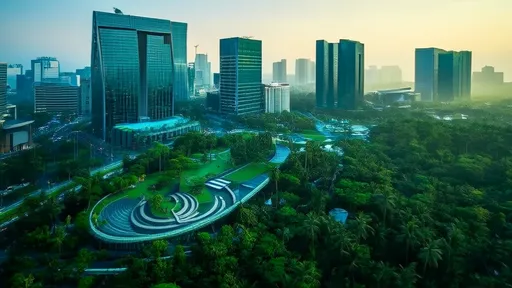
President Joko Widodo's vision for a "smart forest city" becomes tangible at the newly opened Presidential Palace complex. The angular, modernist structure appears to float above a carefully preserved mangrove ecosystem, connected by elevated walkways that give visitors literal treetop perspectives. Solar panel canopies double as shading devices, while concealed rainwater collection systems feed into the surrounding wetlands. It's an architectural statement that aims to prove sustainability and governance can coexist.
Yet beyond these showcase buildings, Nusantara feels more like an elaborate urban experiment than a functioning capital. The much-touted "10-minute city" concept - where all daily needs should be accessible within a short walk - currently translates to long waits for the occasional autonomous shuttle between scattered developments. Early residents (mostly government workers and construction crews) rely on temporary canteens and pop-up markets as permanent commercial infrastructure lags behind schedule.
The forest doesn't make urban development easy here. Construction teams work around protected trees and unexpected wildlife encounters. Cloudbursts frequently turn unfinished roads into muddy obstacles. At night, the lack of light pollution reveals a starry sky rarely visible in Jakarta - but also highlights how few buildings actually stand completed. There's an undeniable magic to these growing pains, a sense of witnessing urban creation from the ground up.
Digital navigation proves surprisingly unreliable in this "city of the future." GPS signals frequently drop near the densest forest patches, and many newly named streets don't yet appear on mapping apps. Locals have developed an amusing practice of directing visitors using half-finished landmarks ("turn left where they're building the circular hospital" or "continue straight until the road becomes dirt"). It creates a peculiar form of exploration where getting lost isn't just likely - it's practically encouraged.
Perhaps the most striking experience comes from standing at what will eventually be Nusantara's urban core. The designated central park area currently resembles a botanical garden crossed with a construction site. Workers plant native saplings between heavy machinery, while biologists tag monitor lizards that wander onto the grounds. The planned "green axis" connecting government buildings remains more dirt path than promenade, yet the scale becomes awe-inspiring when imagining the mature trees and water features that will someday grow here.
Indonesia's grand capital relocation faces enormous challenges ahead - from attracting private investment to building housing for hundreds of thousands of civil servants. But for now, Nusantara offers something rare: the chance to wander through a metropolis as it's being born, where every wrong turn reveals another piece of the puzzle. The unfinished nature becomes part of the appeal, inviting visitors to imagine what might grow from these foundations.
As dusk falls, the forest reclaims its dominance. Fireflies outnumber streetlights, and the daytime sounds of construction give way to a symphony of insects and amphibians. In these moments, Nusantara's core contradiction becomes clear - this is a city meant to tame the wilderness while being tamed by it. The coming years will determine whether that balance can hold as more concrete replaces clay, and more people replace primates. For now, getting lost here means navigating both the promise and the uncertainty of building a capital from scratch.

By /Aug 6, 2025
By /Aug 6, 2025
By /Aug 6, 2025
By /Aug 6, 2025
By /Aug 6, 2025
By /Aug 6, 2025
By /Aug 6, 2025
By /Aug 6, 2025
By /Aug 6, 2025
By /Aug 6, 2025
By /Aug 6, 2025
By /Aug 6, 2025
By /Aug 6, 2025
By /Aug 6, 2025
By /Aug 6, 2025
By /Aug 6, 2025

By /Aug 6, 2025
By /Aug 6, 2025
By /Aug 6, 2025
By /Aug 6, 2025
