The golden sands of Giza have whispered secrets for millennia, but never before have we been granted such intimate access to the pharaohs' sacred chambers. A groundbreaking augmented reality project at the Great Pyramid is rewriting the rules of archaeological engagement, allowing modern explorers to virtually penetrate depths that have been physically inaccessible for centuries.
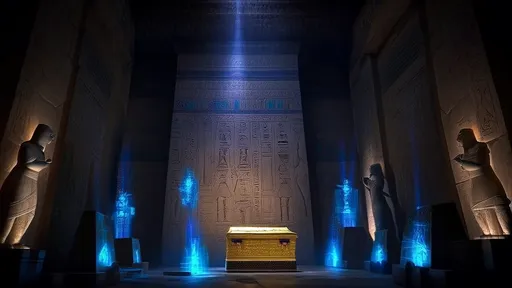
As dawn breaks over the plateau, visitors don sleek AR headsets that transform the ancient limestone facade into a translucent portal. The effect is nothing short of alchemical - what was solid becomes spectral, revealing hidden passageways glowing with ethereal light. This isn't mere projection mapping; the technology uses lidar-scanned data from actual shaft measurements to reconstruct the pyramid's internal architecture with millimeter precision.
The experience begins at the original entrance, where the augmented view superimposes the missing casing stones that once made the structure gleam like a cosmic beacon. As participants move through the Grand Gallery, their headsets populate the space with holographic workmen hauling limestone blocks, their grunts and chatter reconstructed by linguists studying Old Kingdom labor records. The air grows thick with virtual dust - a deliberate sensory detail that makes twenty-first century visitors cough reflexively.
What truly separates this from conventional VR is the tactile feedback system embedded in the gloves. Running fingers along the actual walls triggers precise vibrations mimicking the texture of Tura limestone, while reaching into AR-revealed chambers produces sudden temperature drops corresponding to the pyramid's internal microclimates. At the King's Chamber, visitors feel their palms grow clammy as the system replicates the 80% humidity recorded by recent robotic probes.
The climax comes in the subterranean chamber, where the AR reveals what radar scans suggest lies beyond the walls. A pulsating wireframe model of the suspected Nefertiti's Void expands before participants' eyes, its dimensions shifting between scholarly interpretations. The hologram incorporates recent muon tomography data, visually distinguishing between high-density granite and possible artifact clusters. Egyptologists have programmed the system to update weekly as new scan data emerges from international research teams.
Nighttime sessions offer an even more dramatic experience. The exterior projection transforms the pyramid into a time-lapse spectacle, showing its construction phases across twenty years in twenty minutes. The augmented stars overhead align with astronomically accurate positions from 2560 BCE, revealing how the descending passage targeted Alpha Draconis. Visitors report an uncanny sensation of the ground tilting beneath them as the AR overlays the original 52-degree incline before centuries of sand accumulation altered the base.
Perhaps most revolutionary is the decryption mode, where hieroglyphs along the walls animate to show their evolution from quarry marks to formal inscriptions. Touching a cartouche triggers a cascading translation, with each symbol peeling away into Demotic, then Coptic, before resolving into the visitor's native language. The system even renders hypothetical missing texts based on cryptographic patterns in adjacent chambers.
Critically, this isn't fantasy reconstruction. Every holographic element ties to peer-reviewed research, with controversial elements flagged by color-coded borders indicating their confidence level among Egyptologists. The project team includes specialists from the German Archaeological Institute and digital epigraphers from the University of Chicago, ensuring scholarly rigor permeates each pixel.
As visitors emerge blinking into the sunlight, many describe a paradoxical sensation - having never physically left the entrance corridor, they nonetheless feel irrevocably changed. The pyramid's stones seem to breathe differently afterward, their massive blocks now pregnant with invisible dimensions. Some weep openly; others sit silently pressing their palms against hot limestone, as if trying to feel the echo of holograms that have already faded.
This technological marvel raises profound questions about the nature of archaeological experience. Can a laser-scanned facsimile carry the same numinous weight as physical presence? Does revealing hidden chambers virtually diminish or enhance the mystery? The curators have wisely included a comparison mode showing how Victorian-era explorers imagined these spaces versus our current understanding - a humbling reminder of how each generation projects its own visions onto the past.
For now, the AR experience remains exclusive to on-site visitors, its equipment too sophisticated for consumer headsets. But the implications are staggering. As the technology filters down, we may soon conduct detailed "excavations" of world heritage sites from our living rooms - though whether this constitutes access or appropriation remains hotly debated in academic circles. The sands continue shifting, both literally and metaphorically, at Giza.

By /Aug 6, 2025

By /Aug 6, 2025

By /Aug 6, 2025

By /Aug 6, 2025

By /Aug 6, 2025

By /Aug 6, 2025

By /Aug 6, 2025

By /Aug 6, 2025

By /Aug 6, 2025

By /Aug 6, 2025

By /Aug 6, 2025

By /Aug 6, 2025
By /Aug 6, 2025

By /Aug 6, 2025
By /Aug 6, 2025

By /Aug 6, 2025

By /Aug 6, 2025

By /Aug 6, 2025

By /Aug 6, 2025
By /Aug 6, 2025
